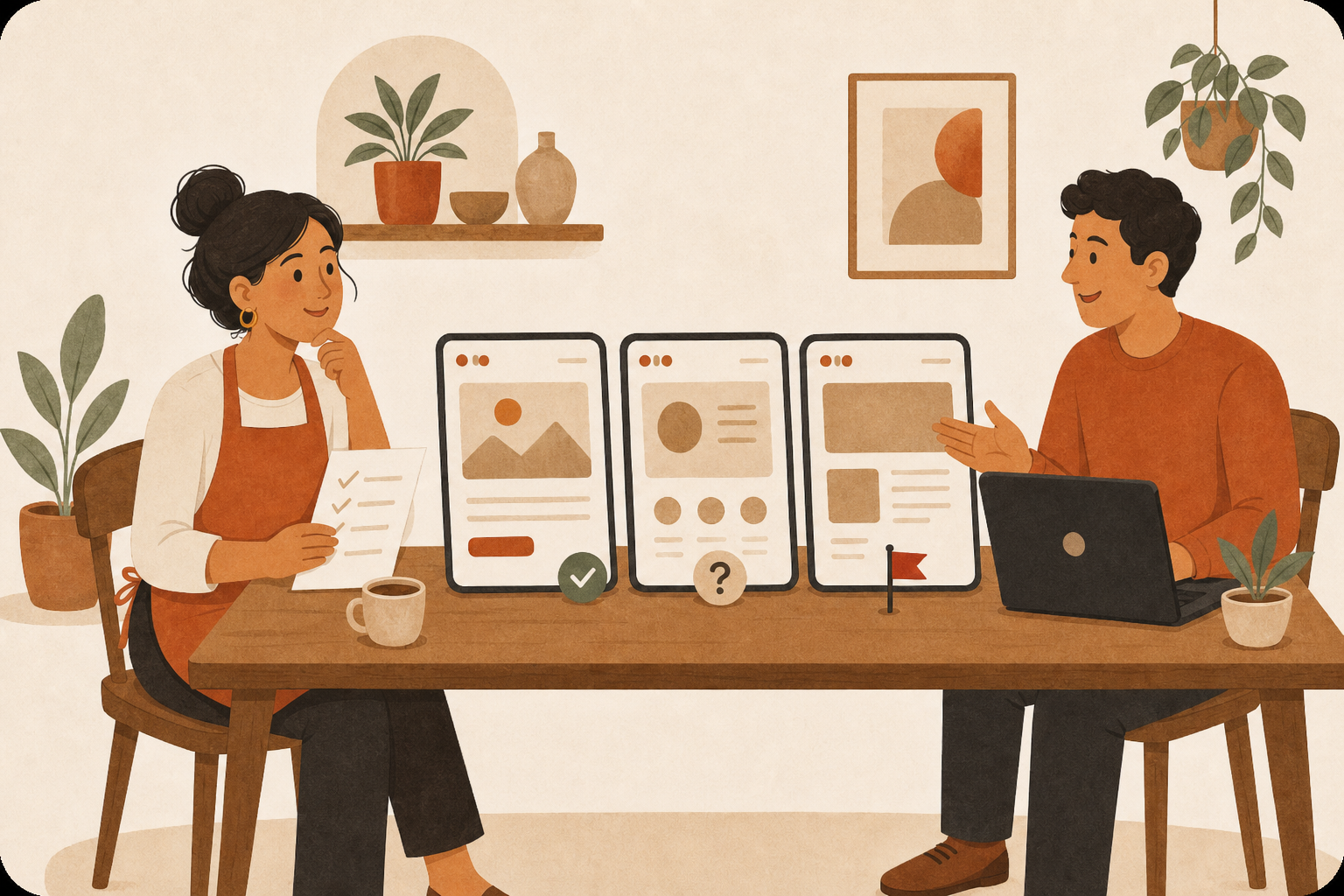
When a local business owner tells me they're shopping for a web designer, the first thing they usually mention is price. Or a mockup that looked sharp in a sales call. Or a friend's cousin who "does websites."
None of that tells you what you actually need to know.
I've spent fourteen years as a software engineer — the kind of work where bad code doesn't just look ugly, it breaks things people depend on. Director-level responsibility, corporate scale, government systems, the whole unglamorous version of "this has to work when it matters." These days I build websites for local businesses in Valdosta and beyond, and the hiring mistake I see over and over isn't picking someone expensive or cheap. It's picking someone without asking the questions that predict whether you'll get a site you're proud of — or another project you have to redo in a year.
This isn't a hit piece on agencies or freelancers. Plenty of good people do this work. I just want you to walk in with your eyes open, because a website is one of the few things your customers judge you on before they've ever met you.
Start with what you actually need
Before you talk to anyone, get clear on the job. Most local service businesses — contractors, salons, clinics, landscapers, the folks I work with most — don't need a twenty-page digital brochure. They need a site that loads on a phone, explains what they do in plain English, makes it easy to call or fill out a form, and doesn't embarrass them when a customer Googles them at a red light.
If that's you, say so out loud when you call. Watch how they respond. Someone who immediately tries to upsell you into a "brand ecosystem" before they've asked what you do for a living is telling you something about how they listen.
Seven questions worth asking before you hire
These are the ones I'd ask if I were hiring someone to build my business site. Not trick questions. Just the stuff that separates a real build from a template with your logo on it.
1. Will I work with you directly, or get handed off?
Some shops sell you in the room and pass you to a junior you've never met. That's not automatically bad, but you should know upfront. If you're a local owner who wants to explain your business once, to one person, and not repeat yourself three times — ask who actually writes the copy, who builds the pages, and who you call when something breaks.
2. Will I see a working preview before I commit?
A PDF mockup is a picture. A working link is proof. I build every project with what I call Live-Link Staging — a real preview on a real URL, so you can tap through it on your phone, send it to your spouse, and know what you're buying before you sign. If someone won't put working pages in front of you until after a big deposit, pay attention to that.
3. What's actually included — in writing?
Pages, yes. But also: who writes the words? Is mobile included or an add-on? Forms? Basic search setup? What happens if you need a change after launch? Vague answers here become surprise invoices later. A clear written scope isn't bureaucracy. It's respect.
4. Who owns the domain, hosting, and site when it's done?
You should. Full stop. If a designer keeps your domain in their account, or won't give you admin access, or holds the site hostage until you pay a monthly fee you didn't understand — that's not a partnership. That's a trap. Ask where the domain will be registered, whose name is on the hosting account, and whether you can leave with your files if you ever want to.
5. What does "after launch" look like?
Websites aren't set-and-forget forever. Something will need a tweak. A form stops sending. A phone number changes. Ask what support looks like, what it costs, and how fast they respond. Silence on this question is how owners end up paying random freelancers to fix a site they already paid someone to build.
6. What's the timeline — specifically?
"A few weeks" isn't a timeline. Ask for a range in writing and what they need from you to hit it. If they can't give you that, they're guessing — and you're the one who waits.
7. Can you show me sites for businesses like mine?
Not just "our portfolio." Sites for businesses with the same kind of customer, the same kind of urgency, the same kind of phone-first traffic. A gorgeous site for a SaaS company doesn't tell you much about whether someone can build a site that gets your HVAC company calls on a Saturday.
Red flags I wouldn't ignore
Price before discovery. If they quote you before they've asked what you do, who your customers are, or what you need the site to accomplish, they're selling a package, not a solution.
"Unlimited revisions." Sounds generous. Usually means no clear process and a project that never ends — or ends when you give up.
Template farms. Thousands of businesses using the same starting layout. Fine for a hobby. Rough when you're trying to look like the person to call in Valdosta or wherever you serve.
You don't get admin access. To your own site. That's not normal.
They won't explain things in plain English. If you leave the call more confused than when you started, imagine how your customers will feel reading the copy they write for you.
Pressure to sign today. Good work doesn't need a fake deadline.
Green flags — what good looks like
They ask about your business before they talk about fonts.
They explain tradeoffs simply, without making you feel dumb for asking.
They show you real work, on real phones, not just desktop screenshots.
They give you a written scope and a written timeline.
They're clear about ownership — you're not renting your own website forever.
They care whether the site brings you leads, not just whether it wins a design award.
That's the bar. It's not impossibly high. It's just higher than "they were the cheapest" or "the mockup looked cool."
Price is a factor — just not the only one
I'm not going to pretend budget doesn't matter. You're running a business. You feel every dollar.
But the cheapest quote often costs more in the end — the rebuild, the fix-the-fix, the year you spent with a site that didn't bring a single call. I've written about that before, and I stand by it: cheap work can quietly cost you more than doing it right once. The goal isn't to find the lowest number. It's to find someone who'll build something that earns its keep.
Compare proposals on what's included, who you're working with, and whether you'll own what you paid for — not just the headline price.
What I'd do if I were you
Talk to two or three people. Ask the same seven questions to each. Take notes. Don't decide on the drive home — sleep on it.
Then walk your gut check: Do I trust this person to represent my business online? Do I understand what I'm buying? Will I own it when they're done?
If all three are yes, you're probably in good hands. If any of them is a no, keep looking. Your website is too visible to get wrong on a rushed choice.
If you're in South Georgia
I work with local service businesses here in Valdosta and nearby — and with small businesses nationwide when the fit is right. Every project starts the same way: a free chat, no pressure, so we can see if I'm the right person before anyone talks about scope or timeline.
If you want to run through these questions with someone who's happy to answer them straight, start here: Contact me
And if you just needed a checklist to compare other designers, I hope this one saves you a headache.
Either way — ask the questions. Your customers will never see the sales call, but they'll feel the choices you made in it every time they land on your site.